The Struggle of Being Called: Divine Election in Jeremiah 1:4–10
BMCC Sunday Sermon · 21 Jun 2026 · Speaker: Dr. Sonia Wong
At some point in every person’s life, there may come a deep, unbidden call — an invitation to leave behind the familiar and step onto a road you have never walked before. This call both stirs the heart and unsettles it. On Sunday, 21 June 2026, Dr. Sonia Wong led the BMCC congregation through Jeremiah 1:4–10, exploring the story of a prophet’s calling and posing a question that is both ancient and deeply personal: When God calls you, what is your first response?
Turn through the pages of the Old Testament, and you will find that nearly every person called by God does not respond with joyful acceptance. They push back, resist, plead for someone else to be chosen. Moses protested that he was slow of speech and tongue; Gideon pointed to the lowliness of his clan within the tribe of Manasseh, the least of families in the least of tribes; Isaiah cried out that his lips were unclean and he was unworthy to stand before a holy God. This pattern — “I am not good enough; I am not the right person” — appears to be a universal human response to divine vocation. The day’s subject, Jeremiah, was no different. Before God’s call, he voiced the honest and helpless words: “Ah, Lord God! Truly I do not know how to speak, for I am only a youth.” (Jeremiah 1:6, NRSV)
Drawing on the work of Old Testament scholar Norman Habel, Dr. Wong explained that call narratives in the Hebrew Bible typically follow a literary structure of six elements: divine encounter, introductory word, commission, objection, reassurance, and sign of confirmation. All six are clearly present in Jeremiah 1. Most striking of all is the divine commission itself: “See, today I appoint you over nations and over kingdoms, to pluck up and to pull down, to destroy and to overthrow, to build and to plant.” (Jeremiah 1:10, NRSV) From the very first moment of his calling, Jeremiah was told not “you shall build” but “you shall first tear down” — a charge so weighty it would give even the most willing heart reason to hesitate.
Dr. Wong organized Jeremiah’s resistance to his calling into three carefully drawn categories: personal factors, contextual factors, and social-psychological factors.
On the personal level, Jeremiah felt he lacked eloquence and was far too young. The Hebrew word used suggests he was under twenty years old at the time of his calling. The prophetic office demanded public speech, debate, and a breadth of life experience that the young Jeremiah felt he simply lacked. Yet Dr. Wong reminded the congregation that God does not evaluate people the way we do. As God said to Samuel: “The Lord does not see as mortals see; they look on the outward appearance, but the Lord looks on the heart.” (1 Samuel 16:7, NRSV) From the moment each person is formed, God has already seen their potential — what they are capable of becoming, not merely what they have been. Furthermore, Jeremiah came from a marginalized priestly family. Scholars have argued that he was likely a descendant of Abiathar, the chief priest under David who fell out of favor with Solomon for supporting a rival claimant to the throne. Abiathar was stripped of his priestly office and exiled to Anathoth. For several centuries after, his line was locked out of Jerusalem’s priestly establishment. Jeremiah was born into this stigma: the lineage of those who were condemned and cast aside, perpetually on the outside looking in. He became what one might call a “prophet from the margins” — a voice challenging the religious power structures of his day from a place of exclusion and inherited shame.
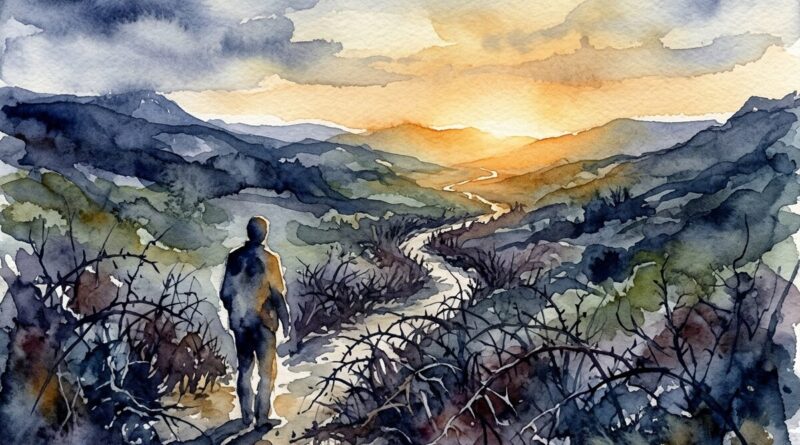
On the contextual level, Jeremiah understood from the outset what accepting the call would cost. His mission was to speak judgment in Judah’s darkest hour, not consolation — to dismantle false reassurances, not reinforce them. His ministry stretched from the thirteenth year of King Josiah’s reign (627 BCE) all the way to the fall of Jerusalem (586 BCE) — forty years of turmoil, forty years of a thorny and dangerous road.
On the social-psychological level, Jeremiah as a prophet, had to confront those in authority and denounce their sins — and faced the real prospect of persecution, even threats to his life. It is telling that the Lord’s very first reassurance to him was “Do not be afraid of them”: the social dangers Jeremiah faced were not imagined but real, and the fear they stirred within him was entirely understandable.
And yet it was precisely this young man — inarticulate, inexperienced, carrying the mark of a disgraced lineage — whom God chose to speak judgment and hope to Judah at its most vulnerable moment. Jeremiah’s task was to break through the numbing illusion: the false peace message that “Jerusalem is under God’s protection and can never fall.” He was called to speak truth in love, to stir a people asleep in comfortable lies back to a faith with deeper roots. For this, he gathered enemies on every side — mocked, arrested, imprisoned, his life threatened, even by his own kinsfolk in Anathoth. Yet he persisted. He knew that those who were “tossed to and fro and blown about by every wind of doctrine, by people’s trickery” (Ephesians 4:14, NRSV) needed someone to speak an honest, loving word — so that their faith might not be left rootless when the storm came.
Dr. Wong’s message invites each of us to find ourselves somewhere in Jeremiah’s story — in the part of us that hesitates when called, that steps back because we feel we are not enough. God’s call does not wait for perfection. What God seeks is a heart willing to be honest about its own weakness, and willing to offer up its hidden potential. Voices called from the margins are often the very ones most capable of breaking through complacency and bringing genuine hope.
Blessed Ministry Community Church (BMCC) is a home that welcomes everyone — whether you feel excluded from the mainstream, or are quietly asking yourself: “Is someone like me worthy of being loved, of being called?” There is a place here for you. Each Sunday, we gather to seek, to grow, and to listen together for the voice that calls us by name. We hope you will come, and find your community, and the hope you have been looking for.