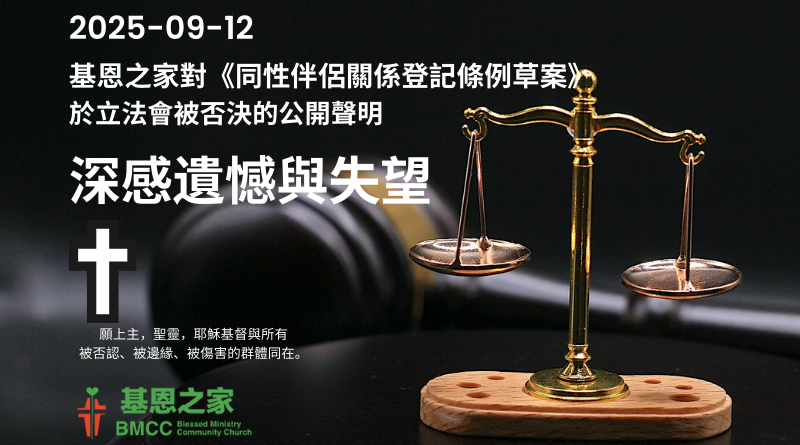
BMCC Statement on the Rejection of the Same-Sex Partnership Registration Bill
Public Statement on the Bill’s Rejection by the Legislative Council
Blessed Ministry Community Church (BMCC) is Hong Kong’s first publicly affirming Christian church for sexual and gender minorities (LGBTQIA2S+), and Asia’s first LGBTQ-affirming church. In 2025 the church has about 70 active members — including same-sex couples planning to marry, same-sex couples already married overseas, bisexual, asexual, transgender and non-binary persons, cisgender heterosexual parents of LGBTQ+ children, and heterosexual believers who have long supported equal family systems. Our Board of Deacons and Co-Workers’ Council together express deep regret and disappointment at the bill’s rejection. We believe this action ignores the court’s ruling and basic human rights; that lawmakers largely substituted personal faith and prejudice for policy discussion; and that the government’s lack of public education has caused widespread social misunderstanding.
We call on the authorities to fulfil their constitutional duty, restart institutional reform, and promote rational dialogue and anti-discrimination education, so that Hong Kong may move toward justice and inclusion. We earnestly urge the government to continue improving the legal framework so that every committed, family-building partnership receives reasonable, equal, and substantive legal protection.
I. Deep Regret and Disappointment at the Bill’s Rejection
This bill was originally a response to the Court of Final Appeal’s 2023 ruling in *Sham Tsz-Kit v Secretary for Justice*. The court found that the government’s failure to provide any legal recognition of same-sex partnerships constituted a violation of the equality rights protected by Article 14 of the Hong Kong Bill of Rights. The court granted a two-year grace period requiring the government to propose institutional remedies. The bill aimed to establish a legal framework recognising same-sex partnerships registered overseas, providing basic protections such as medical decision-making, hospital visitation, and after-death arrangements. Even these baseline rights were unable to pass — a deeply regrettable and disappointing outcome.
The bill was imperfect; its scope of recognition was limited, and its protections were basic. But as a minimal response to the court’s order, it carried important legal significance and social symbolism. Its rejection by the Legislative Council reveals a clear shortfall in implementing fundamental rights protections in Hong Kong, an indifference to minority communities, and risks placing the government on the edge of unconstitutionality and institutional vacuum, facing increasingly urgent constitutional-response obligations. This is not only a failure toward sexual and gender minorities — it also weakens the spirit of the rule of law.
We are deeply concerned: if the government cannot complete remedial measures within the court’s deadline, the unconstitutional state of current arrangements will take immediate effect, leaving same-sex couples without any institutional recognition — entering a legal vacuum and exposing the executive branch and the rule of law to systemic risk.
II. Lawmakers Substituted Personal Faith and Prejudice for Policy Discussion
We note with concern that during the bill’s committee scrutiny, many members reasoned from personal religious belief, prejudice, or stereotypes against LGBTQ+ people, rather than engaging with the constitutional and policy substance — including, frequently, fears of “Western values,” “destruction of the family,” or “moral disorder.” These framings ignore the actual living conditions and concrete protection needs of Hong Kong’s existing LGBTQ+ communities.
We affirm that religion and faith are personal matters and should not become the sole standard for public policy decisions. Public policy in Hong Kong must be rooted in constitutional protection, human rights principles, and respect for diversity — and serve every citizen equally. The Christian faith, as we understand it, does not stand in opposition to equality. It calls us to love one’s neighbour, to do justice, and to walk humbly. We have no need to use faith to oppress, judge, or refuse equal legal recognition to others.
III. The Government Failed to Educate the Public and Misunderstanding Spread
We urge the government to assume responsibility for public education on equality, especially around LGBTQ+ communities. The Hong Kong public’s understanding of same-sex partnership systems is generally limited by misinformation, religious narratives, and inherited stereotypes. Without sufficient public education or policy guidance, the result is that fear-driven, prejudice-driven voices dominate the conversation, drowning out the voices of those most affected — and laying the foundation for the legislative defeat we have seen.
IV. The Way Forward — What We Ask Of Government and Society
We urge the SAR Government to take the following steps without delay:
1. Re-table a constitutional response. A clear plan to fulfil the Court of Final Appeal’s ruling within the deadline — neither delay nor minimalism — and to establish institutional recognition for same-sex partnerships in a manner consistent with the Bill of Rights.
2. Conduct cross-departmental policy review. Identify and amend existing laws and policies that exclude same-sex couples from family-related rights — including (but not limited to) housing, taxation, inheritance, MPF, immigration, and medical decision-making.
3. Promote rational public education and anti-discrimination training. Provide accurate, evidence-based information to the public about LGBTQ+ lives and family structures, in collaboration with educators, family social workers, and civil-society partners.
4. Open public information platforms and consultation channels — to resolve public fears and misunderstanding, and to enhance the policy’s legitimacy. This may include: an FAQ section, channels for public input, regularised community-dialogue venues and schedules, and a stories section centring LGBTQ+ family lives (without demonisation).
If the church can update its theological perspective and re-examine its history and doctrines, it has the opportunity to become a place of healing and welcome. History reminds us that when those with the loudest voice and the most votes act from self-interest, women’s rights were dismissed and slavery was rationalised. The church today is called to prophetic reflection and response.
We urge a “Policy Impact Assessment on the Same-Sex Partnership System” — addressing social, economic, and administrative impact through evidence-based data, dispelling the misunderstanding that the system “tears society apart” and providing a basis for policy implementation.
Hong Kong can once again show the world that it is a city that respects human rights and cares for justice.
May the Lord, the Holy Spirit, and Jesus Christ be with all who have been denied, marginalised, and harmed.
12 September 2025
The Board of Deacons and Co-Workers’ Council
Blessed Ministry Community Church (BMCC)