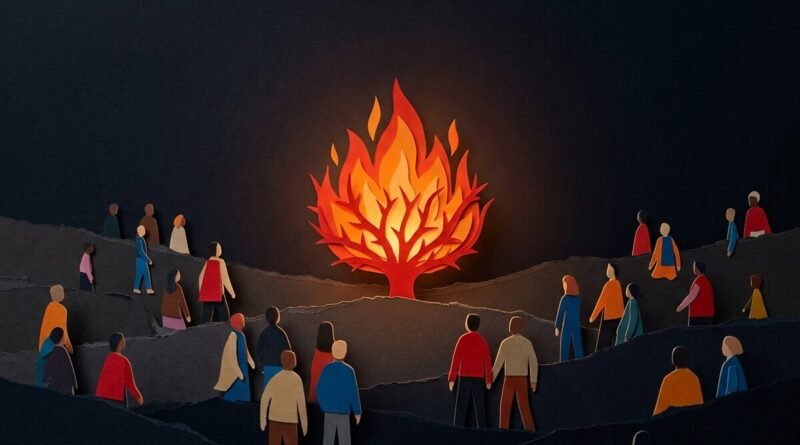
The Burning Bush That Is Not Consumed
BMCC Sunday Sermon · 23 Aug 2026 · Speaker: Pastor Vicky Shiu
When you stand at the most exhausted point of your life — when you feel pressed on every side with nowhere to turn, when the voices you cherish fall silent one by one — can you still hear the echo of hope?
On 23 August 2026, Pastor Vicky Shiu led the Sunday congregation at Blessed Ministry Community Church into stillness with a breathing prayer: “We breathe in God’s breath, strength, and courage; we breathe out our anxiety, our disappointment in ourselves, our disappointment with the world.” In this age of deep weariness, those words seemed to land on a weight many had never put into words.
Before the main message, Pastor Vicky Shiu invited the congregation to recall the last moment they felt God’s call. “When God called Moses, Moses was filled with fear — afraid he was unworthy, doubting himself, afraid others wouldn’t believe him, afraid he had no eloquence.” This honest acknowledgment of self-doubt made those present feel: fear does not mean a lack of faith. It may, in fact, be the starting point of every genuine calling.
Today’s message unfolded in the form of a “four-page sermon,” rooted in Matthew chapter 10, walking the congregation through four movements: the reality of the biblical text, the brokenness of our contemporary world, the Gospel’s response, and our present course of action.
Opening the first page, we returned to first-century reality. Jesus had just called the twelve disciples, and “right away he was training them — and this was not an easy class.” The content was not a success formula, but a forewarning: an honest preview of the three fears the disciples would face.
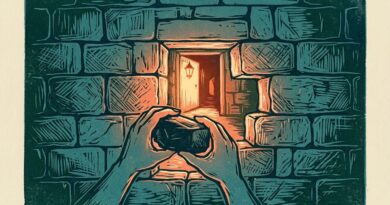
The first fear: the threat to life. The Roman cross was “a most severe form of public execution.” To follow Jesus was to know the road might end in death. The second fear: the tearing apart of relationships. In that era, to be rejected by one’s clan was social death — “following truth means you lose the very places that once sheltered you.” The third fear: truth being buried. What is false is declared true, and the dread is that everything you have stood for may be entombed in darkness under immense pressure.
These fears were real in the first century. But Pastor Vicky Shiu turned the page and asked: “Does this sound familiar?”
This is August 2026. Many things people cherish have quietly faded; many voices within people’s hearts have become difficult to express. The space for open dialogue on certain topics has gradually narrowed. Pastor Vicky Shiu described accompanying theological students — those who genuinely wanted to pursue their own theology and live authentically — bearing an unspeakable exhaustion as they navigated the gaze of traditional churches, the survival constraints of seminaries, and the real struggles of their inner lives.
She also mentioned a person sitting alone in their room, reading a government compulsory purchase notice, confronted by the weight of having to leave. And there was the Tai Po fire that claimed sixteen lives, leaving many still unable to return home.
“That kind of tired,” said Pastor Vicky Shiu, “isn’t about the body — it is a tiredness of the heart.” This weariness is not mere physical depletion, but the weight of a soul that has long survived in the cracks, groping for light in the darkness. As someone who has walked with the dying for twenty years, she said: “Cheap comfort — like telling a patient in bed to just ‘relax’ — is not hope. We must honestly face the darkness. That is where true hope begins.”
Turning to the third page: the Gospel story does not stop at fear. Remarkably, within the same stern teaching, Jesus said “do not be afraid” three times — “like a parent patting a child on the back, three times.”
The first “do not be afraid”: “There is nothing hidden that will not be disclosed, nothing concealed that will not be known.” Unspoken histories, misunderstood names — one day they will be spoken aloud. What is truly beautiful will one day be held in the light. The second “do not be afraid”: “Do not be afraid of those who kill the body but cannot kill the soul.” The danger is real, but danger has a time limit. “We may lose certain connections and opportunities — but no one can take away the God who loves us. God’s love is unceasing.” The third “do not be afraid”: “You are worth more than many sparrows.” The Father is not counting your achievements; he is counting every hair on your head. “He remembers the smallest things about you.” God’s kingdom is not built upon grand institutions — it is built at the margins, at the places where the overlooked find footing.
On the fourth page, Romania spent more than fifty years in an era when religious life was tightly regulated — gatherings were restricted, communities struggled to trust one another, conditions were extremely difficult. Yet within that history, a group of intellectuals and monks quietly built a community in the monasteries, calling it the “Burning Bush Movement.”
They did not work through large revival meetings. In small, quiet spaces, they read together, prayed together, lived together — “scholars have described them as a chosen family.” One central figure had personally endured detention and the shadow of death, yet that wound enabled him to build, even in captivity, “an indestructible university of freedom,” becoming a spiritual father to countless people — and later was counted among the saints.
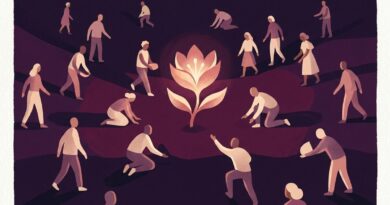
This image brought Pastor Vicky Shiu’s thoughts to the BMCC community: “I think our community is a chosen family.” When the surrounding environment grows difficult, when the ties of one’s birth family have perhaps been severed, “may we become each other’s chosen family, gathering together.”
At the close of the message, Pastor Vicky Shiu offered three lessons. First: when times are difficult, perhaps all that remains is a few people standing together — watching over one another, healing one another — “redefining what shepherding means.” Second: take the hardships and make them the material of theology. “Contextual theology, feminist theology — none of it was produced in a comfortable study. It all emerged from crisis, from people walking together through hardship and seeking how to hold on.” Third: learn to protect yourself, set boundaries, and “allow yourself to rest.”
She closed with a profound image: “This community, in its difficulty, becomes that burning bush — burning here, but not burned up, because the Lord is in our midst. Do not fear the hardships of this world or the darkness of difficult circumstances. The Father’s hands still hold us.”
Blessed Ministry Community Church (BMCC) is a home that welcomes everyone. Whatever weariness you carry, whatever fears and struggles you face on the path of faith — here is a community willing to keep watch with you in the dark, to discern together the light that pierces through it. You do not have to burn alone. Every Sunday, we are here, waiting for you to come home.