How Should an LGBTQ+ Christian Live? — BMCC’s Trainee Missionary on Pluralistic Theology
One Sunday in mid-April, I visited BMCC at an old building on Nam Cheong Street in Sham Shui Po for the Sunday service. The day’s sermon was titled “I am not ‘sinful,’ but neither am I ‘holy.'” The trainee missionary Cheng Tze-hong (known as Hong) opened by asking: “What sins do we have?” From the seats someone shouted: “Homosexuality!” Laughter rippled through the thousand-square-foot sanctuary.
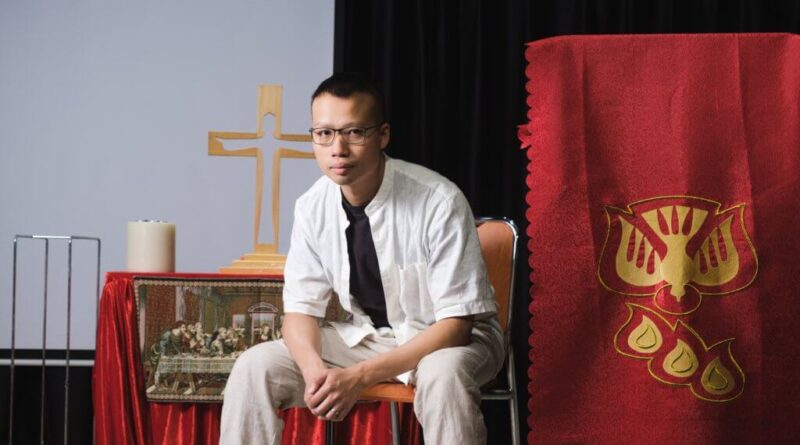
BMCC was Hong Kong’s first Protestant church founded by LGBTQ+ Christians, and Asia’s first formally registered LGBTQ+ Christian organisation. Hong jokes he can no longer remember how long he has served here. He started attending church at twelve, was baptised at eighteen, has been at BMCC for more than ten years, and is now a trainee missionary as well as a full-time musical-theatre teacher in primary and secondary schools. He believes that “finding the rhythm” is central to life — and that he has found his. Right now, he is an LGBTQ+ pastoral worker, and on the recurring question “How should an LGBTQ+ Christian live?” he has confidence in his answer.
Embracing Pluralistic Theology
Six passages from the Bible are frequently cited to argue that Christianity opposes homosexuality. Hong has also lived through the traditional-church years and understands how difficult it is for sexual minorities to be received in those communities. Information was scarce when he was younger; for a time he was lost. “When I was little, you believed what others told you. If others said you were sinful, you were sinful.” His original church was sizable — close to two thousand members. He recalls once arriving late and being seated in the last row: looking toward the distant platform, the physical and the psychological distances felt equally far. He found it hard to build relationships in his old church, but found belonging at BMCC.
“For me, our church’s theology is pluralistic. Pluralism means that each member’s theological view will be different. Pluralistic theology means I respect your theology — I don’t need to say your God is wrong.” They consider faith through the lens of “progressive theology.” “One key angle of progressive theology is that, whether or not the events in the Bible happened, we can read them as parables. The same way we read Chinese history or world history — we can learn from what people experienced.” He explains that the Bible was assembled by those who held power at the time. “What ideology to instil in those they ruled, or in their congregations; how they wanted society shaped and what they wanted to get from it — many factors influenced this. So how can I take the Bible as 100% truth?” Worth pondering: “Does the content really fit the society we live in today?”
He says faith is broad, and the Bible is not the whole of faith. “If someone has questions about a passage, you can tell them the Bible is only one part — faith is vast, and you have to discern through your own experience, your culture.” “Faith has many facets, many different theologies. Old traditional churches may have preached only one theology, all anchored on the literal Bible.” He says he still has on his bookshelf works published by groups unfriendly to LGBTQ+ people — “New Creation Association,” “Society for Truth and Light,” and others. “If you think those are sins that separate you from God, that is what you need to work through. But I don’t feel bound by these — my relationship with God is built on love and justice.”
Setting aside religious language, what Hong believes is, in fact, simple. “The only thing real is the exchange between you and me here and now — our lives are real.” Hong describes his own struggle around sexual orientation as minimal.
A Queer Pastoral Worker’s Social Responsibility
As the service drew to a close, a second-generation Christian member shared: because their mother required them to attend the same church, they could not regularly come to BMCC. Hong noted that such stories are not unusual. Before BMCC moved to Sham Shui Po, the church was in Sheung Wan. In those years, while most churches held morning worship, BMCC’s started at four in the afternoon — because many members had to attend a different church in the morning.
The church has grown, and they too have grown. Today the service is at eleven in the morning, and the sanctuary is full. They no longer wish to label themselves as an “LGBTQ+ church”: “Although most of us are sexual minorities, we don’t want to sever our connection with the wider community.” The church was formerly called “Blessed Minority Christian Fellowship”; it is now “Blessed Ministry Community Church” — a small but deliberate change of name.