The Tiller’s Characters
BMCC Sunday Sermon · 12 Jul 2026 · Speaker: Dr. Dino Wong
On a Sunday in July, just before International Non-Binary People’s Day (14 July), Blessed Ministry Community Church (BMCC) welcomed Dr. Dino Wong, a clinical psychologist and long-time advocate who has spent over a decade working on the front lines of gender minority services. Taking the Parable of the Sower in Matthew 13 as his foundation, Dr. Wong invited the congregation to read a familiar passage through fresh eyes — to rediscover the nature of God’s grace, to reimagine the church’s mission, and to reconsider what role each of us plays in it.
For a long time, when people encounter the Parable of the Sower, the habitual response has been to map the four soils onto different “types” of people — and conclude: “The problem is that your soil is not good enough.” Dr. Wong pointed out a blind spot in this reading: the condition of the soil is, in large measure, shaped by external forces beyond any individual’s control. The roadside has been compacted by years of foot traffic; it represents the souls worn down by relentless social pressure, their inner lives so compressed that there is no space left to receive or digest. The rocky-ground people may be those on the margins, chronically discriminated against and without support, unable to put down roots. Those among the thorns may be trying to numb unhealed wounds through the pursuit of status or material comfort. Jesus, Dr. Wong argued, was not issuing moral grades on human character; he was describing the real, often structurally imposed conditions in which people find themselves.
Dr. Wong then drew attention to a key Hebrew word in Matthew: 明白 (understanding). In Hebrew, this does not simply mean memorising facts. It means that, upon hearing God’s word, a person integrates that message with the depths of their own pain, longing, and struggle — so that their will, emotions, and the direction of their life are genuinely transformed. The seeds in the parable are not agricultural specimens; they are the message of the Kingdom of Heaven. When a person hears and truly understands, life becomes abundant — thirty, sixty, a hundredfold. The question is never about a person’s intellectual capacity; it is about whether the condition of their soil allows the seed to take root.
With this in mind, Dr. Wong asked: if God is the true Sower, what is our role? He pointed to the gleaning laws in Leviticus: Israelites were required to leave the corners of their fields unharvested and not to gather fallen grain — it was to be left for the poor and the resident foreigner. To a Jewish audience hearing this parable, the image was unmistakable: here is a God who scatters seed even onto the margins, without asking whether the soil “deserves” it. The grace of God is indiscriminate. And the mission entrusted to the church — the Great Commission at the close of Matthew’s Gospel — is to participate in that same plan of unconditional love. Dr. Wong also urged that, alongside personal witness, faith communities can provide concrete services — schools, English classes, food distribution, hospitality — that remove the structural weeds from people’s soil, allowing seeds to germinate. He encouraged members simply to share a cup of coffee with a new attendee after worship, to take turns visiting those who are unwell, to walk alongside people in their struggles without judgment: “What we care about is their lives, not the KPI.”
The sermon reached its turning point when Dr. Wong named two indispensable attitudes for those who would sow: humility and patience. He confessed that in his own past work he had, without fully realising it, come to expect visible fruit from those he served — measuring their growth against an internal timetable and standard of “healthy progress.” He named this for what it was: a hidden arrogance, the assumption that love and effort should yield a measurable return. Then came the realisation: “The one who causes life to grow is God. The one who activates the seed of life is God. We are only assistants.” An active farmer weeds, fertilises, and builds shelter for the seedlings — doing everything within his power — and then surrenders the outcome to God. Patience, he said, means being willing to accept that God’s work unfolds beyond our narrow horizons and timetables. He recalled a historical account: a missionary in the nineteenth century who, alone, worked in a rented room in Guangzhou for seven years under significant constraints and personal hardship, to translate the Bible into Chinese. By every human KPI, those seven years looked like complete failure — he even had to quietly conduct a companion’s baptism by the seaside secretly. Yet that hidden labour became a cornerstone of the development of Christianity in China. “God’s plan does not run on the same KPI as ours.”
The most moving part of the message was Dr. Wong’s own testimony. He admitted that during his university years he was lost and without direction. Then, at a lecture at the University of Hong Kong, a guest speaker spoke about the difficult situation of gender minority people — how they were marginalised, how they were misunderstood by the medical system. In that moment, something opened in him: a calling to enter that field and serve this community. “That speaker could not have imagined what seed they took care of in a young person that day.” Over the decade that followed, Dr. Wong grew into his calling, sustained by the community and companions around him who patiently watered the ground. A single seed does not always sprout immediately. But when someone is willing to tend it with patience, transformation comes — in God’s own time.
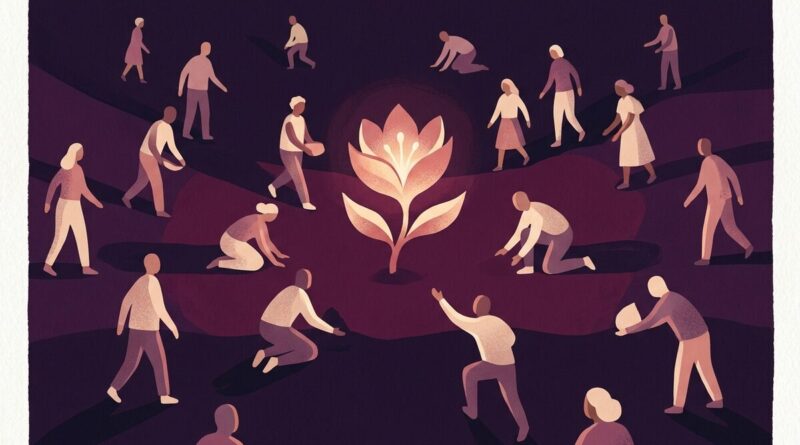
Dr. Wong closed by inviting everyone to imagine a field where many seeds grow together, each at its own rhythm — some bearing thirtyfold, some sixtyfold, some a hundredfold. He had initially pictured a productive orchard, but came to see it differently: it is more like a scenic landscape garden, because God tends every different plot, every plant grows at its own pace, and the whole place becomes colourful and harmonious in its diversity. “Not every plant needs to bear the same fruit. This land is God’s garden.” In this garden, we connect with one another, protect one another, and share together in love and effort.
Blessed Ministry Community Church is a home that welcomes everyone. Whatever soil you are standing on right now, however barren your life may seem, there is a community here willing to set aside judgement and grow alongside you, in God’s light, at whatever pace your life allows. We gather every Sunday. If you are looking for a place where you can be freely yourself, you are welcome to come.