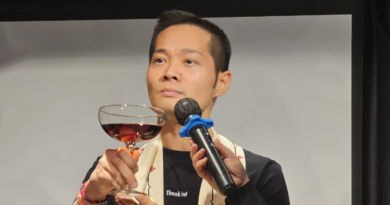

Eighteen Years of Trauma, Now Diagnosed With Complex PTSD — Alvin Cheung’s Story
Alvin Cheung’s story is a long one. Eighteen years have passed since he underwent “conversion therapy.” In 2005, at the Christian-background “New Creation Association,” he completed a year of “conversion therapy” — service aimed at sexual minorities and their families. Even after the therapy ended, the trauma has haunted him. “These eighteen years felt like falling into a black hole — a hole where time and space are warped, very different from outside. Those on the outside couldn’t see how to help me, and I couldn’t see how to get out.”
The “conversion,” he says, began before the therapy and did not end with it. “Conversion is a continuous process of internalising society’s expectations.”
Denying His Own Homosexuality
Hong Kong did not officially decriminalise same-sex sexual acts until 1991. Alvin, born in the 1980s, recalls a world that uniformly stigmatised homosexuality. His parents were Christian; he grew up attending church; the church did not accept homosexuality; his father even arranged acupuncture sessions for him hoping to change his orientation. Meanwhile, media and popular culture stuck negative labels on the LGBTQ+ community. “I think sexual-orientation discrimination is a cultural oppression of an entire culture.” From a young age he denied his identity as gay; very early he had “internalised homophobia”: “Society thought only heterosexual was right; gay was wrong.” In secondary school, classmates teased the way he ran as “girly.” “I remember writing in my yearbook: ‘I am not gay’ — going out of my way to explain that I was not gay.” “Constantly believing I wasn’t ‘gay’; that I liked girls — doing this unconsciously. From a young age I was already ‘converting’ myself.”
In university he developed feelings for a fellow Christian classmate, and came out to him. The classmate could not accept it, telling Alvin: “It’s okay, God can help you” — and recommended he contact New Creation Association. Already loathing his own gay identity, Alvin slowly fell into a black hole. The association required him to sign a counselling contract specifying that the counsellor could choose the appropriate method. Reading the clauses now, Alvin finds them unfair — he was under the influence of cultural prejudice and unable to give informed and conscious consent.
Therapy Felt Like Abuse and Humiliation
That year he was twenty-one, studying engineering at CUHK with a music minor — devoted to the clarinet. His former routine had been practicing music with a male classmate he liked; after “conversion therapy” began, the friend was still beside him, but they no longer played music together. The counsellor instructed Alvin to “build healthy friendships with the same sex” and labelled his feelings for the friend “emotional dependence.” “They have a theory — that once you build healthy same-sex friendships, you’ll gradually come to like the opposite sex.” Under the counsellor’s instructions, Alvin and his male friend “took on the homosexuality inside together.” “One counselling exercise was to call him on the phone, and he would hang up on me — to break my heart.”
Eighteen years later, returning to CUHK for this interview, Alvin sat in the place he once practised clarinet, reading two diaries he kept during therapy. “In the diary I would even write: ‘Your refusing me like that — you really did well.’ Looking back, the repeated calling and being hung up on internalised into a feeling of being abused or humiliated. But I would tell myself this was for my own good — that I was clearing the demon inside me. Counselling was about taking on my own sexuality, taking on the gay part of me.” Torn paper notes Alvin keeps come from the diary written during “treatment,” when, under the counsellor’s influence, he was constantly searching for the “cause” of homosexuality.
The counsellor also invited him to “Life Renewal” small-groups — with claims that he needed “companions on the journey.” In the group, a series of sexual minorities listened to sharings from pastors, social workers, and doctors. They guided members in a “brainwashing” way — not to continue walking the gay path. The group leader said: “If you like someone of the same sex, think about that person’s bad points.” So every time Alvin felt attracted to anyone, he would start cataloguing their flaws. Over the year, he absorbed the association’s denials of homosexuality — that gay people are “sick, sinful”; that “gay relationships are chaotic, without true love”; he watched his own counsellor — once gay — claim to have changed, having married a woman and had children. For a time he thought he could follow the same path. He was in extreme repression; once, on the counsellor’s request, he attempted a year of celibacy. “If I saw a shirtless man on TV…”
After Eighteen Years — Diagnosed With Complex PTSD
The trauma did not end with the therapy. For eighteen years, Alvin lived with depression and anxiety. Last year he was diagnosed with complex PTSD. The diagnosis became the start of finally being able to name what had happened to him.
Now, he is committed to walking with other LGBTQ+ survivors through counselling — “I hope there won’t be another victim.”
“Conversion is a continuous process,” he repeats. The struggle is not only with what was done in those years, but with the cultural oppression that made them feel inevitable.